If your ESG and carbon reporting already feels like a year-end scramble, what happens when the number of frameworks you must satisfy — and the scrutiny on every figure — multiplies?
For the sustainability, finance, and risk leaders we work with across India, the honest answer is that the current approach won't survive the next few years. ESG and carbon data is heading into a period of real turbulence, and most organisations are preparing for it with the same spreadsheets that already strain under today's demands. The enterprises that come through it well won't be the ones with the best intentions — they'll be the ones that treated this as a data problem early.
Here is what's coming, and how to get ahead of it.
Four forces converging into chaos
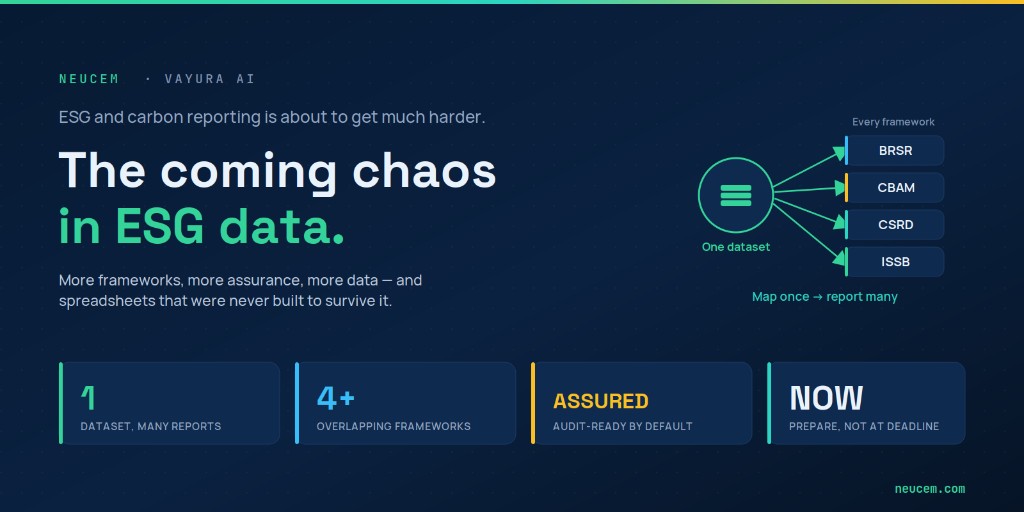
First, regulatory proliferation. It is no longer one framework. Indian enterprises are navigating SEBI's BRSR and BRSR Core, exporters face the EU's CBAM demanding embedded-emissions data on goods, and global groups contend with CSRD/ESRS and the ISSB standards. These regimes overlap but don't align — different boundaries, metrics, and timelines — so the same underlying reality has to be expressed many different ways.
Second, assurance. Disclosure is shifting from self-reported to independently assured. BRSR Core brings assurance to key metrics, and investors and auditors increasingly expect a defensible trail behind every number. Estimates that were "good enough" for a voluntary report won't survive an assurer's questions.
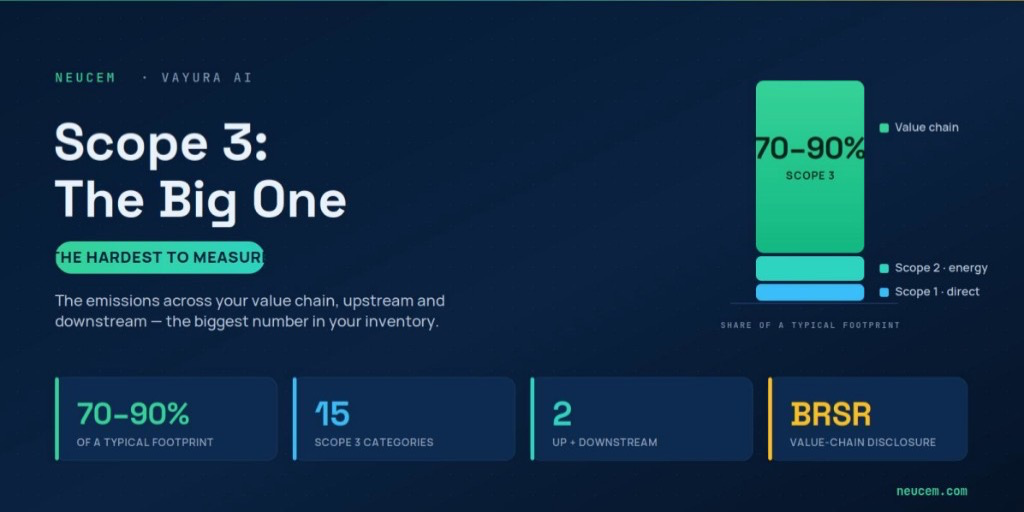
Third, a data explosion. Scope 3 and value-chain reporting push the data boundary far beyond your own operations — into thousands of suppliers and product-level footprints. The volume, granularity, and number of sources are rising by an order of magnitude.
Fourth, shifting ground. Methodologies, emission factors, and boundaries are still evolving. What you report this year may need restating next year — which is manageable if your data is versioned and traceable, and a nightmare if it isn't.
Why spreadsheets break under this
A spreadsheet-based, annual process fails on every one of these fronts. It is manual, so rising volume overwhelms it. It is built for one framework, so each new regime means rebuilding from scratch. It has no lineage, so it cannot survive assurance. And it is a point-in-time snapshot, so it can't keep up with continuous demands. The tool that got you through your first BRSR filing is not the tool that gets you through the next five years.
How enterprises should prepare
The preparation is the same regardless of which regulations land hardest: build the data foundation now, while there is time to do it well rather than under deadline.
Treat carbon and ESG as data infrastructure, not a report. Put a governed, automated pipeline underneath the numbers — ingesting from your systems and suppliers continuously, not scrambling once a year.
Map once, report many. Hold your data in a framework-agnostic model, so a single governed dataset can feed BRSR, CBAM, CSRD, and ISSB without re-collecting everything each time. This is the highest-leverage decision you can make.
Make everything assurance-ready by default. Attach lineage to every figure, version your emission factors, and keep the trail intact — so an audit is a query, not an excavation.
Go continuous. Move from an annual-filing mindset to an always-current inventory, so a new requirement is a configuration change, not a crisis.
How Vayura AI helps you get ahead of it
This is exactly what we built Vayura AI to do. It ingests and standardises ESG and carbon data across your operations and supply chain, holds it in a governed, framework-agnostic model, and attaches lineage to every number — so you can satisfy multiple regimes from one dataset and stay assurance-ready as standards shift. When the next framework or restatement arrives, you adapt a configuration rather than rebuild a process. The chaos becomes manageable because the foundation was built for it.
Where Neucem fits
We treat this for what it is: a demanding data-engineering problem in service of a compliance and climate outcome. With Vayura AI and the engineers behind it, we help enterprises replace fragile, framework-specific spreadsheets with a durable data foundation — one that turns the coming turbulence from an existential scramble into routine operations.
The chaos is coming either way. The only question is whether your data is ready for it. Learn more about Vayura AI and our AI services at neucem.com.