The concepts behind carbon accounting are not difficult. The bookkeeping is. That is the problem Vayura AI, the carbon accounting platform from Neucem Technologies, is built to solve. It brings four capabilities into one place — Unified Ingestion that pulls activity data from the systems where it already lives, a Governed Factor Library of versioned emission factors, AI Classification & Extraction that sorts spend and reads supplier documents, and Audit-Ready Lineage that traces every figure back to its source. This piece takes the jargon apart — Scope 1, 2 and 3 in plain terms — then shows what it actually takes to produce numbers that survive an audit.
The Three Scopes, in Plain Terms
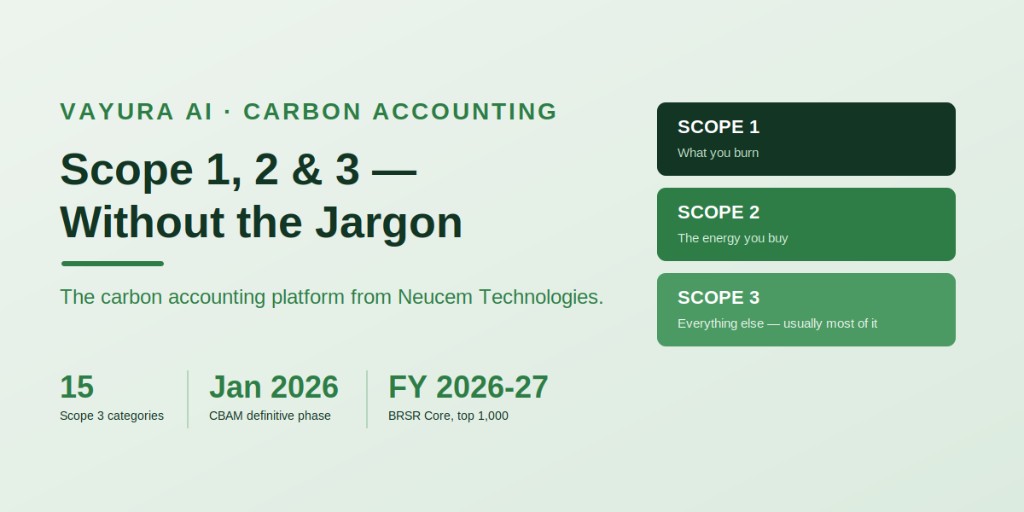
The Greenhouse Gas Protocol splits a company's emissions into three buckets. The split follows who controls the emission and who pays for the fuel.
Scope 1 is what you burn. Fuel combusted in assets you own or control — diesel gensets, furnace gas, boiler coal, refrigerant that leaks from chillers, and the fuel in your own fleet. If the combustion happens on your premises or in your vehicle, it is Scope 1.
Scope 2 is the energy you buy. Almost entirely purchased electricity, plus purchased steam, heat, or cooling. You did not burn anything — the generator did — but the demand was yours. There are two accepted methods: location-based applies your grid's average emission factor; market-based reflects what you actually contracted for, such as a renewable PPA or green tariff. Most Indian companies now report both, and the gap between them is the story your procurement team is trying to tell.
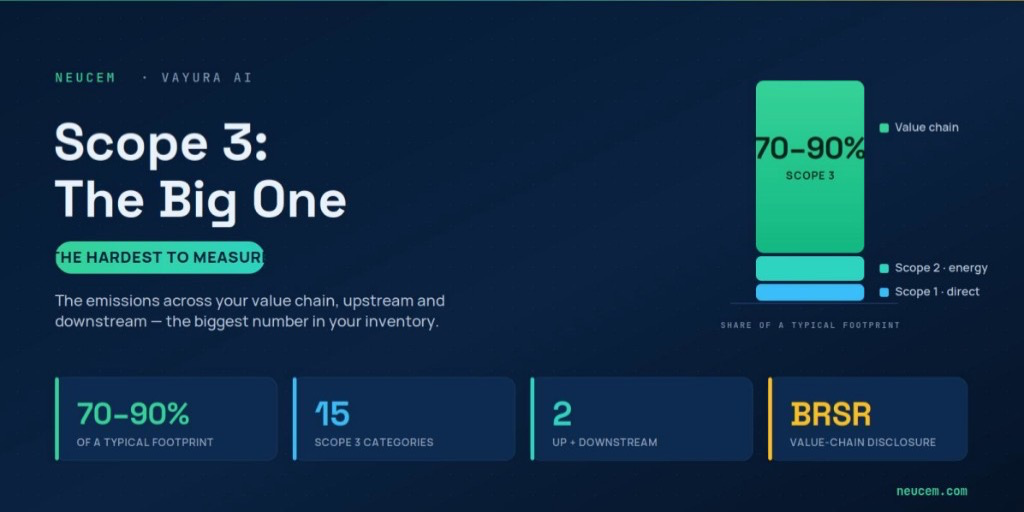
Scope 3 is everything else. Fifteen defined categories covering emissions that happen because of your business but not inside it — purchased goods, capital goods, upstream transport, business travel, commuting, waste, and, for many manufacturers, the use and end-of-life of products you sold. For most organisations, Scope 3 is the majority of the footprint, often several times larger than Scope 1 and 2 combined.
Why Scope 3 Is the Hard One
The difficulty is structural, not technical. Scope 1 and 2 data belongs to you — it sits in fuel logs, meter readings, and electricity bills. Scope 3 data belongs to other people.
To calculate emissions from purchased goods, you need to know what your suppliers did. Most Indian suppliers, particularly in tier two and tier three, cannot tell you. So companies fall back on spend-based estimation: multiply rupees spent by an average factor. It is a legitimate starting point, and it is also blunt — it implies that spending more on the same steel raises your emissions, and that a supplier who decarbonises earns you nothing. Moving from spend-based to activity-based data — actual tonnes, actual kilometres, supplier-specific factors — is where the effort concentrates, and where most programmes stall.
The Capabilities Vayura AI Is Built On
Vayura AI treats emissions data the way finance treats financial data: structured, traceable, and defensible line by line. Four capabilities make that possible.
- Unified Ingestion. Rather than asking sustainability teams to re-key numbers, Vayura AI pulls activity data directly from the systems where it already lives — ERP purchase and production records, utility and fuel invoices, fleet telematics, and logistics manifests.
- Governed Factor Library. A versioned, governed library of emission factors so that two plants cannot silently apply two different factors to the same fuel — the single most common source of inconsistency in manual carbon accounting.
- AI Classification & Extraction. AI does the genuinely repetitive work: classifying spend lines into the correct Scope 3 categories, extracting values from unstructured supplier documents, and flagging outliers before an assurer finds them.
- Audit-Ready Lineage. Every figure carries lineage back to its source record. When an assurance provider asks where a tonne came from, the answer takes seconds, not days.
Why the Bookkeeping Now Matters More Than the Concept
Two changes have turned emissions data into audited data for Indian companies, and both reward good bookkeeping directly.
BRSR Core. SEBI's assessment-or-assurance requirement for BRSR Core KPIs — which include GHG emissions — has been phasing in by market capitalisation, reaching the top 1,000 listed entities from FY 2026-27. Once a number is assured rather than merely disclosed, it needs an evidence trail: source document, factor, calculation logic, approver. That is exactly what Audit-Ready Lineage provides.
CBAM. The EU's Carbon Border Adjustment Mechanism entered its definitive phase on 1 January 2026. Indian exporters of steel, aluminium, cement and fertilisers now face a direct commercial consequence: where verified installation-level data is not available, EU default values apply — and those are set at the conservative end of the range. Poor data no longer just creates compliance risk; it raises your landed cost against competitors who measured properly.
What Good Looks Like
The difference shows up when the auditor arrives. In a spreadsheet-based process, assembling the evidence for a single figure means chasing plant managers, reconciling timestamps, and hoping the factor someone used last year can be found. With Vayura AI, the figure, its factor, and its source record are already linked — so the assurance conversation is about interpretation, not archaeology. The same discipline that satisfies an assurer also gives management a number it can actually plan against.
The Numbers at a Glance
Why emissions bookkeeping is now a scheduled priority for Indian companies:
- 3 scopes defined by the GHG Protocol — Scope 1 (burn), Scope 2 (buy), Scope 3 (everything else)
- 15 Scope 3 categories, usually the majority of the total footprint
- 2 accepted Scope 2 methods — location-based and market-based — both now commonly reported
- CBAM definitive phase began 1 January 2026 for steel, aluminium, cement, fertilisers
- €75.36/tonne first quarterly CBAM certificate price (April 2026)
- Top 1,000 listed entities reached by BRSR Core assessment-or-assurance from FY 2026-27
- EU default values apply where verified data is missing — deliberately conservative
Vayura AI is the carbon accounting platform from Neucem Technologies — bringing Unified Ingestion, a Governed Factor Library, AI Classification & Extraction, and Audit-Ready Lineage into one place so emissions data is treated like financial data: structured, traceable, and defensible. We work talent-first, with clean architecture and honest estimates: engagements typically begin with a data and readiness assessment of what you already measure, what you estimate, and what your next audit will ask for. Whether you need a single specialist or a full delivery team, we scale to fit. To see what your own footprint looks like when the bookkeeping is audit-ready, request an assessment at neucem.com.