You've measured your Scope 1 and Scope 2 emissions and feel you finally have a handle on your carbon footprint — so what do you do when the largest part of it is still missing from the picture?
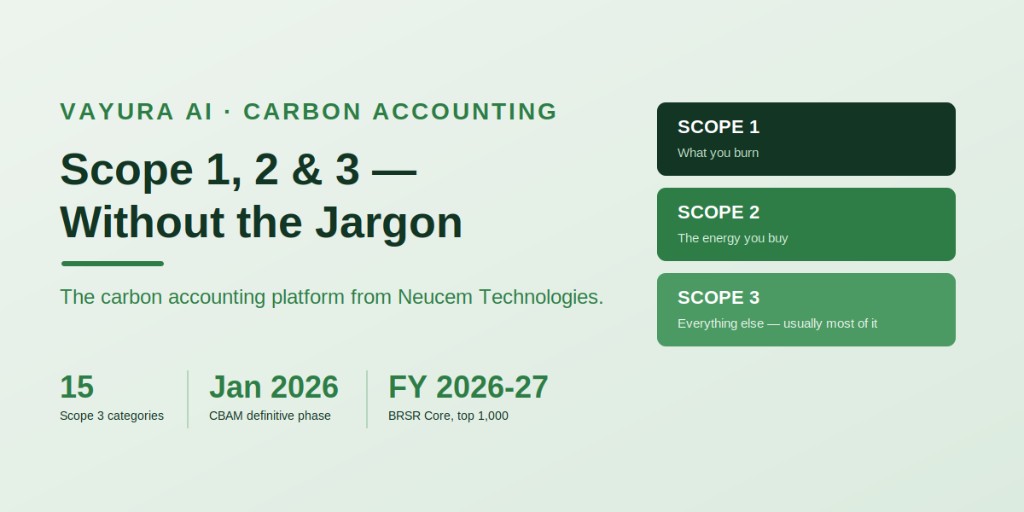
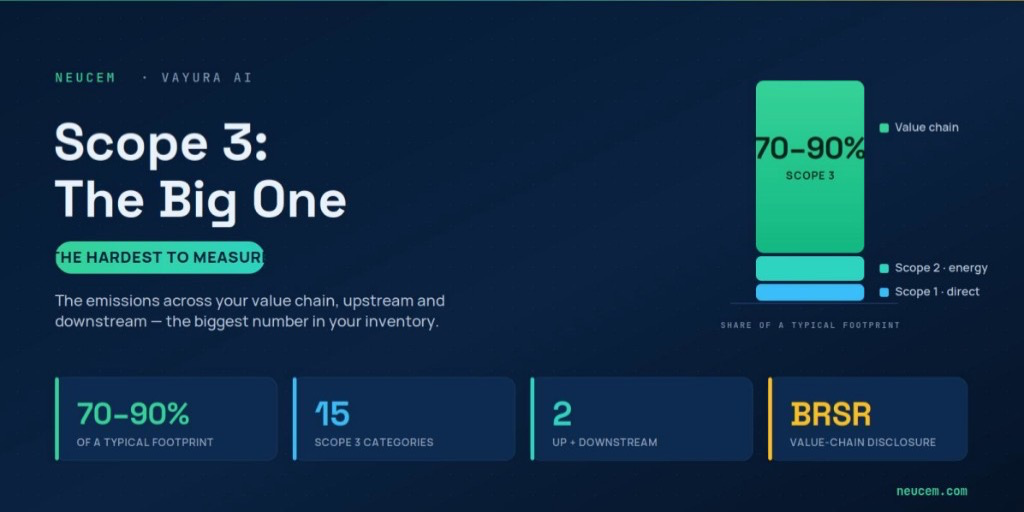
For the sustainability, finance, and supply-chain leaders we work with across India, that is the uncomfortable reality of Scope 3. Under the GHG Protocol, Scope 1 covers the emissions you produce directly and Scope 2 covers the energy you purchase. Scope 3 is everything else — the emissions embedded across your value chain, both upstream and downstream. For most organizations it is not a rounding error. For a typical corporate footprint it is 70–90% of the total. It is the footprint.
What Scope 3 actually covers
Scope 3 spans fifteen categories in two directions. Upstream sits everything you buy and the effort to bring it to you: purchased goods and services, capital goods, fuel- and energy-related activities, transportation, waste, business travel, and employee commuting. Downstream sits everything that happens after your product leaves: distribution, processing, the use of sold products, and their end-of-life treatment. For a manufacturer, purchased goods alone can dwarf every direct emission the company reports. For a services firm, it might be cloud usage and business travel. The categories that dominate differ by sector but in almost every case, the bulk of the number lives outside your own four walls.
Why the biggest number is also the hardest
The difficulty follows directly from that fact: you are trying to measure emissions you do not directly control and cannot directly meter. Four problems compound.
First, the data belongs to other people — suppliers, logistics providers, and customers whose systems, priorities, and reporting maturity vary enormously.
Second, there are fifteen categories to account for, each with its own methodology and boundary.
Third, most Scope 3 figures are estimated rather than measured: organizations multiply spend by an average emission factor because activity-level data isn't available. That gets you a number, but a coarse one that barely moves when you actually decarbonize.
Fourth, what supplier data you do receive arrives in inconsistent formats, with gaps and a real risk of double-counting across categories and partners.
The result is a familiar bind. The number that matters most is the one you can least trust — and the effort to improve it is exactly the effort most teams don't have the capacity to sustain manually.
Why this is now urgent in India
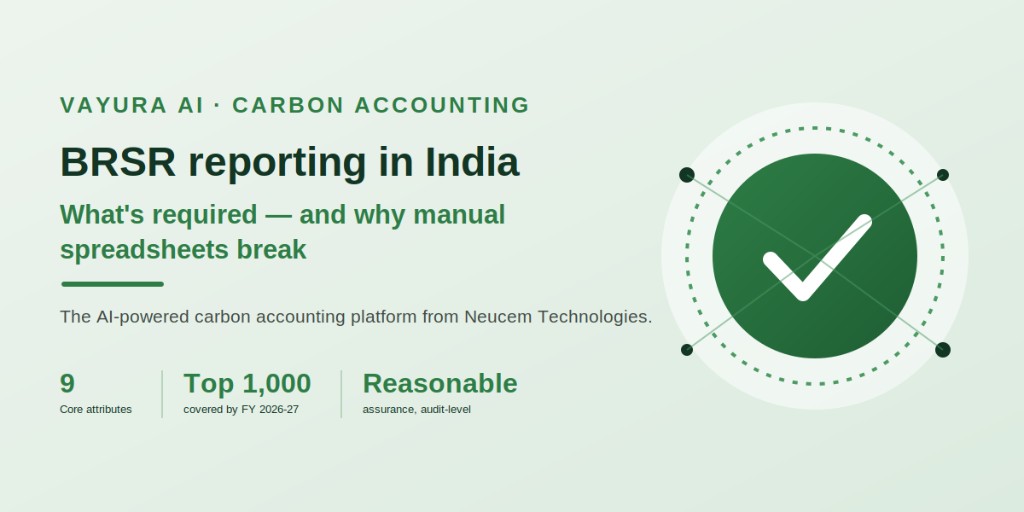
This is no longer a voluntary exercise. Under SEBI's BRSR framework, and BRSR Core in particular, India's largest listed companies are expected to report and assure value-chain data — which pushes Scope 3 from a sustainability aspiration into a disclosure obligation with your name on it. Investors, lenders, and large customers are asking the same questions. Retrofitting a defensible Scope 3 inventory after a reporting deadline lands is slow, expensive, and rarely convincing.
How Vayura AI closes the gap
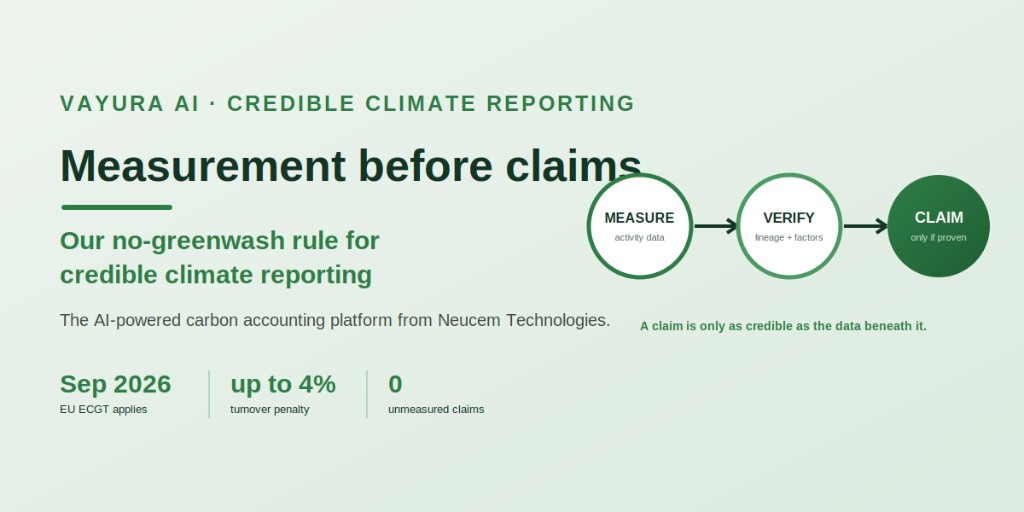
We built Vayura AI to make Scope 3 tractable as an ongoing operation rather than an annual scramble. It automates the collection and validation of supplier data across categories, so information arrives structured and comparable instead of as a spreadsheet flood. It maps procurement spend to the right emission factors and uses AI to fill defensible gaps where primary data is missing, then helps you replace those estimates with activity-based figures as real data comes in. Crucially, every number carries its provenance, so what you disclose is audit-ready for BRSR from the outset rather than reconstructed under deadline.
The effect is a Scope 3 inventory that improves over time instead of resetting each year — one accurate enough to guide actual reduction decisions, not just satisfy a form.
Where Neucem fits
Scope 3 is fundamentally a data-engineering problem wearing a sustainability label: messy inputs from many sources, methodology that has to be applied consistently, and outputs you must be able to defend. That is precisely the intersection where we work. With Vayura AI and the engineers behind it, we help you turn the hardest number in your inventory into one you can measure, improve, and stand behind.
If Scope 3 is the part of your footprint you understand least, that is not a reason to wait — it is the reason to start now. Learn more about Vayura AI and our AI services at neucem.com.