Why do so many capable services companies — teams that ship excellent software for clients every single day — stall the moment they try to build a platform of their own?
It is one of the most common patterns we see in India's technology sector, and one of the most frustrating. A services firm has the engineering talent, the client relationships, and the domain knowledge. It decides to move up the value chain and build its own product. Two years and a great deal of money later, the platform is half-built, perpetually behind, and quietly shelved. The problem is rarely a lack of skill. It is a structural trap — and it is avoidable once you can see it clearly.
The paradox: great at delivery, stuck at product
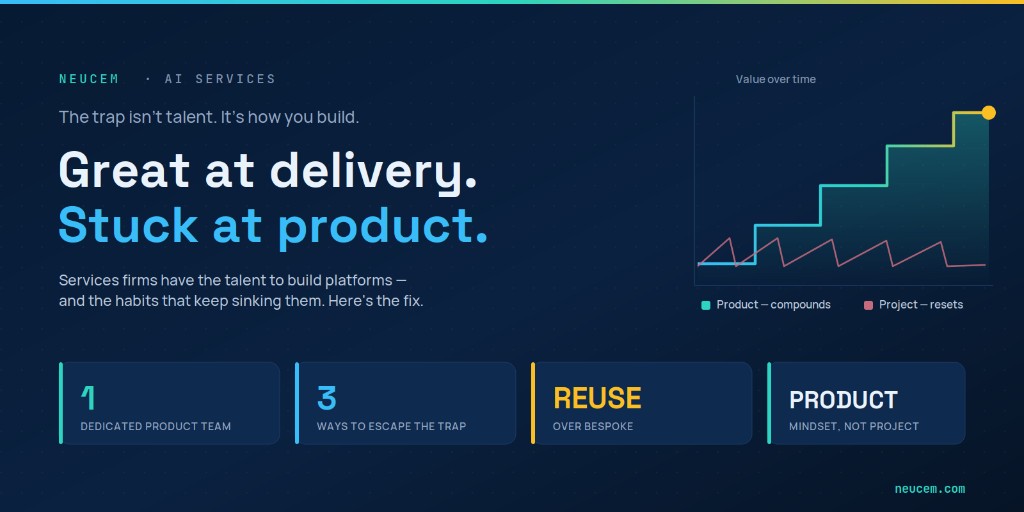
Services excellence and product excellence look similar from the outside and are wired very differently underneath. Services delivery optimises for a specific client, a fixed scope, and a deadline — build exactly what was asked, bill the hours, move to the next engagement. Product building optimises for many users you haven't met yet, an open-ended scope, and a roadmap measured in years. The very habits that make a services firm excellent — responsiveness, bespoke solutions, billing by the hour — are the habits that quietly sink a platform.
How the trap springs
Four forces pull in the wrong direction.
First, the project mindset. A platform gets scoped, staffed, and managed like a client project — with an end date. But products don't have end dates; they have lifecycles. When the "project" ships, the team disbands and the platform begins to rot.
Second, the economics. Every hour spent on the internal platform is an hour not billed to a client. In any resourcing conflict between paying client work and a speculative platform, the client wins — every time. The platform starves.
Third, the bespoke instinct. Services teams are trained to build exactly what one client wants. Platforms require the opposite discipline: building something reusable for many, which means saying no to one-off requests and holding an opinion about what the product is and isn't.
Fourth, no product ownership. Client work has a project manager tracking scope and deadlines. A platform needs a product owner deciding what to build and, harder, what to refuse — a role services organisations often don't have.
How to avoid it
The fixes follow directly from the forces.
Ring-fence the product. Give it a dedicated team and its own budget, insulated from the services P&L, so it can't be raided every time a client deadline looms. A platform funded from spare capacity is a platform that never ships.
Build for reuse, not for one. Treat every feature as something many users will touch, and be willing to refuse bespoke requests that would turn your product back into a pile of custom projects. An opinionated platform beats an infinitely flexible one.
Lead with product, not projects. Put a real product owner in charge, working to a roadmap and outcomes rather than a fixed scope and an end date. Measure adoption and value, not tickets closed.
And fund it like an investment, not an expense. Platforms compound — each release builds on the last — but only if you give them the patient capital to get past the flat early years. Judge them on the curve, not the quarter.
Where Neucem fits
We say all this as a services company that has built platforms — so we know the trap from the inside, not just the whiteboard. That experience is exactly what we bring to clients making the same journey. Whether you are a services firm moving up the value chain or an enterprise building an internal platform, we help you build with product-engineering discipline — ring-fenced teams, reusable architecture, and a roadmap that compounds — rather than repeating client-project habits on an asset that needs something else entirely.
If you have tried to build a platform and watched it stall, the problem probably wasn't your engineers. It was the trap. Learn more about our AI services at neucem.com.