The hardest part of enterprise AI is no longer the model. Models are commoditised, capable, and available through an API. The hard part is everything around the model — the data plumbing, the integration into real systems of record, the evaluation discipline, and the ownership that keeps a system running after launch. That is the work Neucem Technologies is built to do. Through our Dedicated AI/ML Teams, Full-Stack & Cloud Engineering, Custom Software & Product Engineering, Talent & Staff Augmentation, and Managed Remote / Outsourced Teams, we help enterprises cross the gap where most projects stall. This piece walks through why pilots get stuck, and the specific gates — each mapped to how we help — that separate the systems that ship from the ones that quietly die.
The Pilot Succeeds at Being a Pilot
Most stalled AI projects are not technical failures. The demo works. The steering committee is impressed. The model does what it was asked to do on a clean, curated slice of data.
The problem is that the pilot was scoped to impress a room, not to survive a workflow. It ran in a sandbox with hand-picked inputs, no live integration, and no one owning the result on day 400. It succeeded at being a pilot — and being a good pilot is not the same as being a shippable product. This is the exact gap our Dedicated AI/ML Teams are structured to close: engineers who build, train, deploy, and maintain AI/ML systems as part of your extended setup, rather than handing over a prototype and walking away.
What the Data Actually Says
The failure numbers circulating in 2025 and 2026 are striking, and worth reading with care rather than as a single headline.
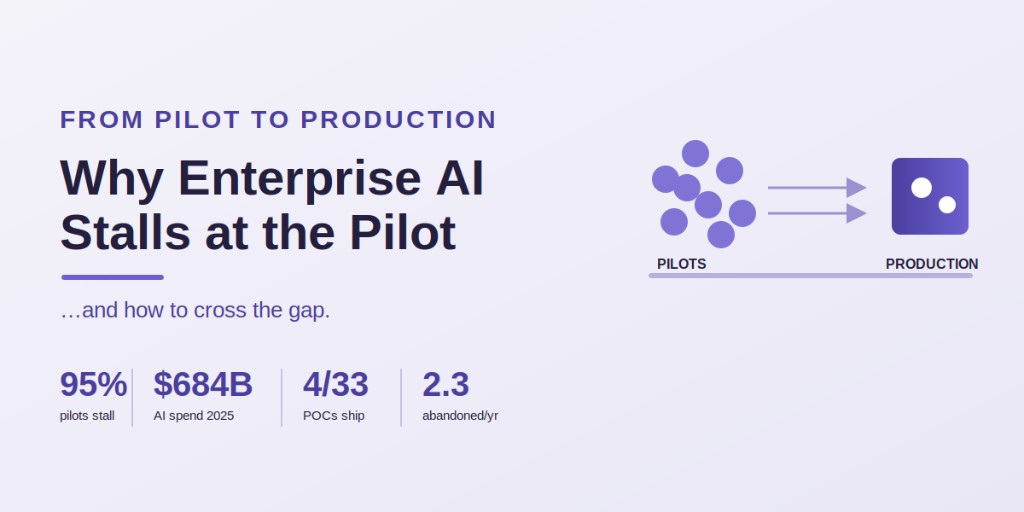
MIT's Project NANDA report, The GenAI Divide: State of AI in Business 2025, is the source of the widely quoted figure that roughly 95% of enterprise generative-AI pilots deliver no measurable P&L impact. It is worth noting this is a preliminary finding, not peer-reviewed, based on interviews and a review of around 300 public deployments — a strong signal, but one report rather than settled science.
Other studies triangulate the same direction. RAND's analysis put the share of AI projects failing to deliver intended business value above 80%. IDC's work is often summarised as only four of every thirty-three proofs of concept reaching production. The exact percentages differ because they measure different things — shipping, ROI, sustained value — but the direction is consistent: most enterprise AI work does not cross the pilot-to-production gap.
The Real Bottleneck Is the Integration Layer
Ask why, and the technically inconvenient answer is that the model was never the bottleneck. The work around the model is.
A pilot deliberately avoids the hard integration — it reads from a clean export, not the live ERP or ticketing system. Production cannot. Connecting an AI system to the actual systems of record, with their permissions, edge cases, latency, and messy history, is frequently underestimated by an order of magnitude. This is precisely the surface our Full-Stack & Cloud Engineering service covers — frontend, backend, cloud infrastructure, DevOps pipelines, QA and deployment — so the integration layer the pilot skipped is engineered properly rather than bolted on at the end.
Dirty Data With No Owner
Behind most stalled integrations sits a data problem that predates the AI project entirely.
The pilot ran on a curated dataset someone cleaned by hand. In production, that data arrives dirty, inconsistent, and — critically — with no clear owner. Nobody is accountable for its definitions, its freshness, or its lineage. An AI system built on ungoverned data produces output that cannot be validated, and output that cannot be validated cannot be trusted enough to run a business process. Our Talent & Staff Augmentation service exists for exactly this gap — giving you access to data scientists, AI/ML engineers, DevOps and cloud specialists who can own the data foundation before the model is trained, not after it misbehaves.
No Success Metric, No Forcing Function
The most cited root cause is also the least technical: no measurable business objective tied to the project from day one.
If nobody defined what production success looks like — a number, a threshold, a decision the system must improve — there is no forcing function to complete the journey from experiment to deployment. Reviews get renewed, expectations quietly drop, and the project drifts into what the industry now calls pilot purgatory: neither cancelled nor scaled, consuming budget and credibility while delivering neither. When we engage through Custom Software & Product Engineering, the success metric is fixed at the scoping stage — the deliverable is a working production outcome tailored to scale, not a demo that impresses a committee.
Pilot Fatigue Is the Compounding Cost
The damage is not confined to a single stalled initiative. It accumulates.
The first pilot stalls and the budget is quietly renewed. The second stalls and champions disengage. By the third, executives stop attending the reviews. Each failed cycle erodes the institutional appetite and the credibility needed to make the next attempt succeed. Our Managed Remote / Outsourced Teams — flexible project-based, retainer, or hybrid models with dedicated project management and 24/7 support — exist to break that cycle, giving a stalled programme a delivery engine that is accountable for shipping rather than for running another pilot.
How to Ship: Four Gates Before You Scale
Crossing the gap is less about a better model and more about refusing to start without four things in place. Each maps to a Neucem service.
- A production success metric, defined on day one. Not "explore whether AI can help" but "reduce first-response time on this queue by X, measured this way." We fix this in the scoping stage of any Custom Software & Product Engineering engagement.
- The integration scoped in, not out. Build the pilot against the real system of record from the start, even at small scale — the remit of our Full-Stack & Cloud Engineering teams.
- A named data owner. Someone accountable for the definitions, quality, and lineage of the data the system depends on. Filled directly through Talent & Staff Augmentation or an embedded Dedicated AI/ML Team.
- Ownership on day 400. Name the team, the runbook, and the on-call rotation that will hold this system eighteen months out — the standing role of our Managed Remote / Outsourced Teams.
The Numbers at a Glance
The pilot-to-production gap, in figures from 2025–2026 research:
- ~95% of enterprise GenAI pilots delivered no measurable P&L impact (MIT Project NANDA, preliminary)
80% of AI projects fail to deliver intended business value (RAND)
- 4 of 33 proofs of concept reach production (IDC)
- ~$684B spent on AI in 2025, with the majority not delivering measurable business results (industry estimates)
- 2.3 AI initiatives abandoned on average by large enterprises in a single year (S&P Global)
- 3–5× typical gap between production GenAI running cost and initial projection
- Most-cited root cause: no production success metric defined at the start
Neucem Technologies helps enterprises cross the pilot-to-production gap with five engagement models: Talent & Staff Augmentation, Dedicated AI/ML Teams, Full-Stack & Cloud Engineering, Custom Software & Product Engineering, and Managed Remote / Outsourced Teams. We work talent-first, with clean architecture and honest estimates — starting from a readiness assessment of your data, integration surface, and success metrics rather than a model demo, then building incrementally with ownership and runbooks transferred as we go. Whether you need a single specialist or a full dedicated team, we scale up or down to fit. To pressure-test a stalled pilot or scope one properly from the start, request a readiness review at neucem.com.