How many AI tools does your organization run today — and how many of them actually talk to each other?
For the CIOs and CTOs we work with across India, the honest answer to the first question is usually "more than we can name," and to the second, "very few." Over the past few years nearly every function has bought its own AI point solution — one for support, one for analytics, one for forecasting, one bolted onto the monitoring stack. Each looked sensible in isolation. Together they have produced something no one intended: a sprawl of tools that generate outputs but never add up to intelligence.
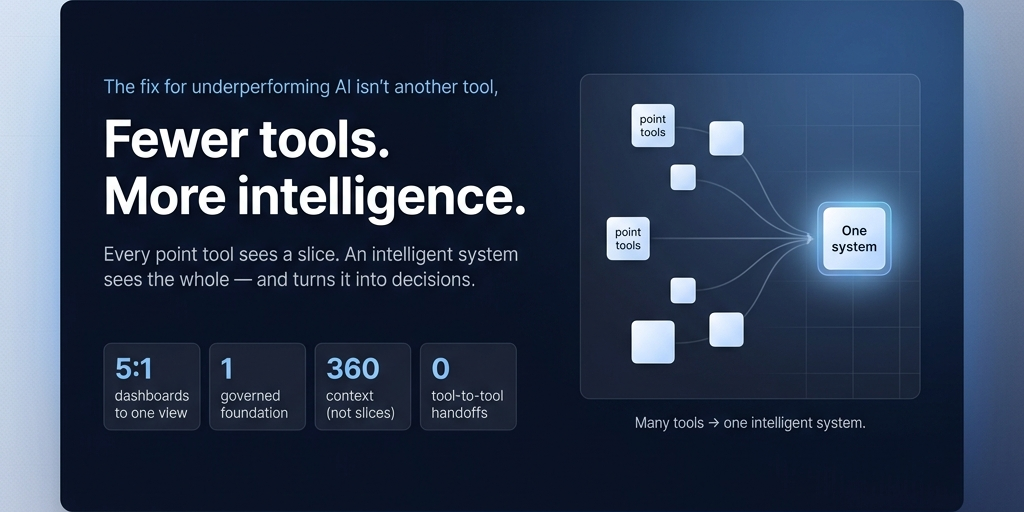
The instinct when AI underdelivers is to add another tool. We think the opposite is usually true. Enterprises need fewer tools and more intelligent systems.
The hidden cost of tool sprawl
Every new AI tool arrives with its own copy of your data, its own definitions, its own access model, and its own dashboard. Multiply that across a dozen tools and the costs compound quietly. Data is duplicated and drifts out of sync, so two tools give two answers to the same question. Context is fragmented — each tool sees only its slice, none sees the whole. Governance splinters across a dozen consoles, so no one can say with confidence who accessed what. And your team pays a permanent "integration tax," stitching outputs together by hand before anyone can act.
The result is motion without progress: plenty of AI activity, and decisions no better informed than before.
Why more tools don't add up to more intelligence
Here is the core issue. Intelligence doesn't live inside any single tool — it emerges from connected context. A model that sees one slice of your operation can optimize that slice, but it cannot reason about the whole. Ten such tools don't combine into something smarter; they combine into ten disconnected opinions that a human still has to reconcile. Adding an eleventh doesn't close that gap. It widens it.
An intelligent system is different in kind, not degree.
What an intelligent system actually looks like
Three properties separate a system from a collection of tools.
First, one connected data foundation — a single governed source the whole system reasons over, instead of fragmented copies that disagree. Second, shared context — every part of the system works from the same complete picture, so an output in one place is informed by everything known elsewhere. Third, decisions rather than outputs — the system doesn't hand you five dashboards to reconcile; it brings the relevant signals into one place so you can decide, with the underlying detail one click away.
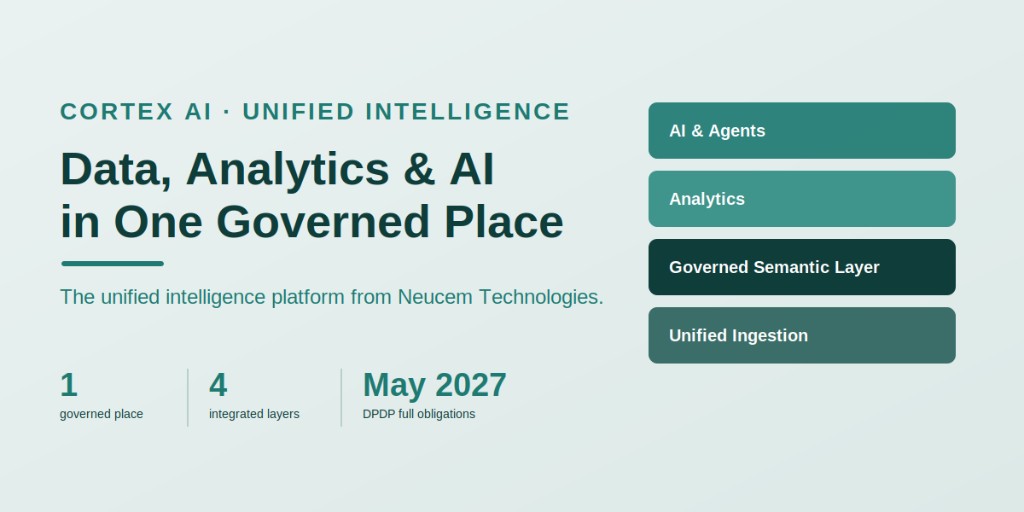
That is the principle Cortex AI is built on: data, analytics, and AI in one governed system, designed to produce decisions rather than yet another feed to interpret.
A familiar scenario
Picture an operations team with five tools open — a monitoring platform, a ticketing system, a BI dashboard, a spreadsheet, and someone's inbox. Before anyone can act, an analyst spends the morning reconciling them by hand. Replace those five fragmented views with one intelligent system, and the same signals arrive already connected, already governed, already pointed at the decision. The morning of stitching becomes minutes — and the decision is better because it is whole.
Where Neucem fits
We help enterprises do the harder, more valuable thing: consolidate. With Cortex AI, we replace tool sprawl with a single governed system that turns scattered data and models into decisions you can trust and trace. Fewer moving parts, lower integration cost, one version of the truth — and, finally, intelligence rather than just tools.
If your AI estate has grown faster than your ability to make sense of it, the answer probably isn't one more tool. Learn more about Cortex AI and our AI services at neucem.com.