A unified intelligence platform is a single governed environment where operational data lands once, is modelled consistently, and is served to both analytics and AI under the same access, lineage, and retention rules. That is what Cortex AI, the unified intelligence platform from Neucem Technologies, is built to be. It brings four capabilities into one place — Unified Ingestion, a Governed Semantic Layer, Analytics, and AI & Agents — so that the number on an executive dashboard and the input to a production model trace back to the same source, under the same rules. This piece explains what that means in practice, why fragmented data quietly defeats analytics and AI investment, and why, for Indian organisations, governance has moved from good practice to a scheduled obligation.
One Governed Place, Not Four Disconnected Ones
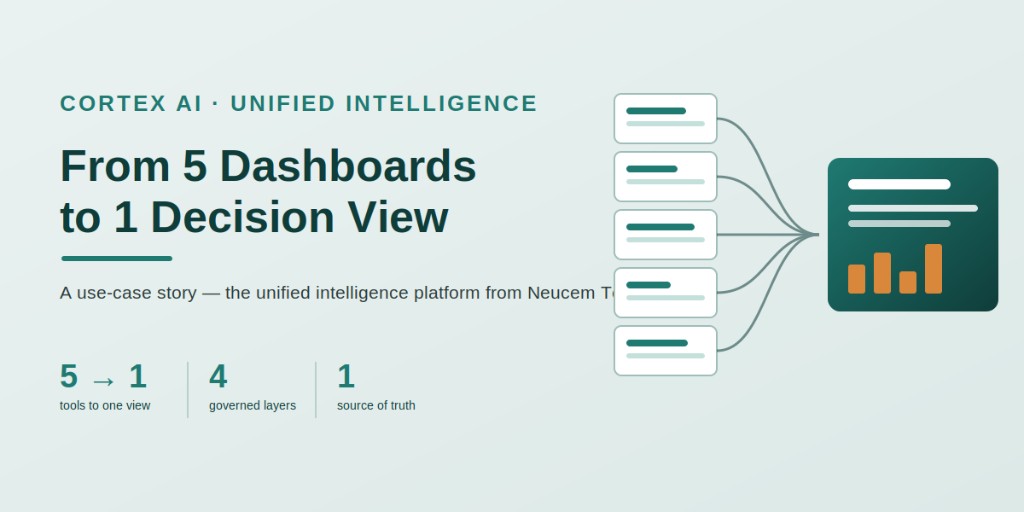
In most enterprise, telecom, and managed-service environments, operational truth is split across systems that were never designed to talk to each other. Telemetry sits in one platform, ticket history in another, experience scores in a vendor dashboard nobody outside one team can license, and capacity planning in a spreadsheet on someone's laptop.
Each system is individually correct and collectively useless, because no single one can answer a cross-cutting question — why a service degraded, what a customer's true cost-to-serve is, where a process actually breaks. Cortex AI exists to collapse that fragmentation into one governed place, which is a different thing from a dashboard or a rebranded data lake.
What a Unified Intelligence Platform Actually Is
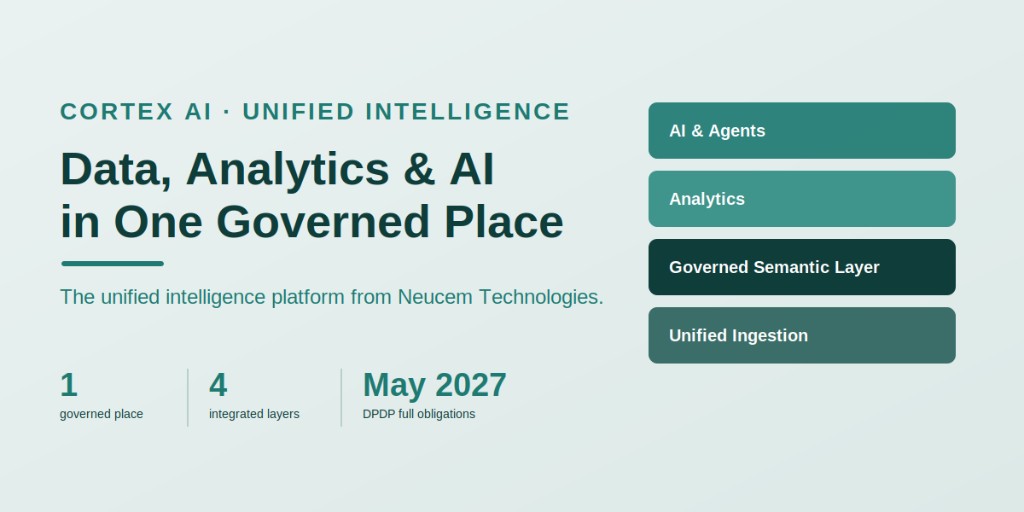
The distinction matters. A dashboard shows you numbers someone else assembled. A data lake stores raw files. A unified intelligence platform does neither on its own — it is the governed layer in between, where data is landed once through Unified Ingestion, given shared meaning in the Governed Semantic Layer, and then made available to both Analytics and AI & Agents without being re-copied, re-defined, or re-permissioned in every tool.
The test of a real unified intelligence platform is simple: can any figure on any screen be traced to its source, and does every team calculate the same metric the same way? If not, you have integrated tools, not unified intelligence.
The Four Layers Cortex AI Is Built On
Cortex AI is designed as four layers that work together rather than four products bolted together.
- Unified Ingestion. Streaming and batch pipelines pull from controllers, application logs, ERP and ticketing systems, sensors, and third-party feeds into open table formats — one landing pattern, not one per source.
- Governed Semantic Layer. Shared definitions of the entities the business actually reasons about — customer, site, incident, transaction, SLA breach — so that a metric like "success rate" stops being an opinion and becomes a single governed definition.
- Analytics. Dashboards, ad-hoc query, and reporting read from the semantic layer rather than from raw tables, so consistency is enforced upstream and does not have to be policed in every report.
- AI & Agents. Anomaly detection, forecasting, root-cause assistance, and natural-language query all operate on the same governed data, with the same permissions and full lineage back to source — which is what makes their output trustworthy enough to act on.
Governance Is the Load-Bearing Layer
The word most often skipped in this conversation is governed, and it is the one that decides whether the platform survives contact with production.
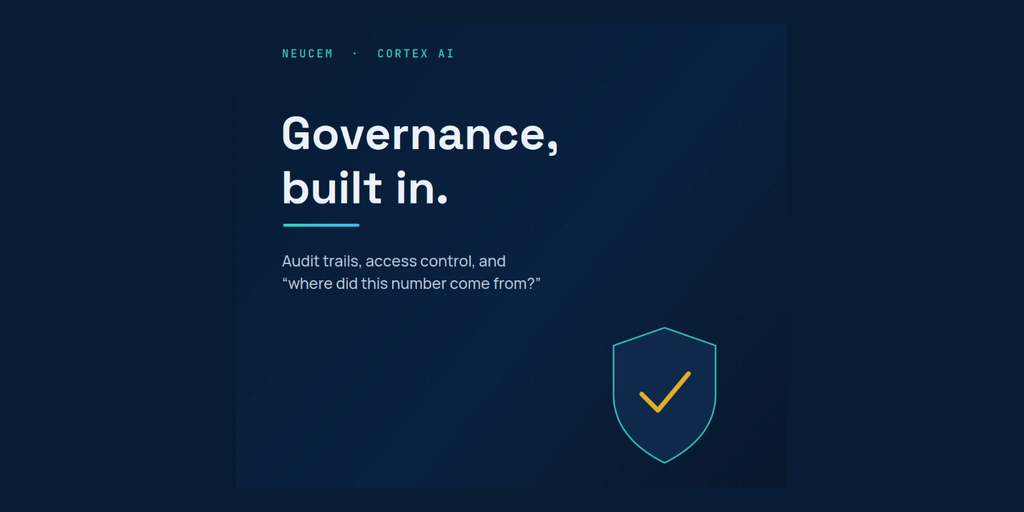
In Cortex AI, governance is not a policy document — it is enforced in four concrete ways: access control applied once at the data layer rather than re-implemented in every tool; end-to-end lineage so any number traces to its source; catalogued, classified data so teams know what exists and how sensitive it is; and enforced retention and residency. An AI system built on ungoverned data produces confident output nobody can validate, and output nobody can validate cannot be trusted to run a business process.
Why This Is Now on a Clock in India
For Indian organisations, governance has moved from good practice to a scheduled legal obligation.
India's Digital Personal Data Protection (DPDP) Rules were notified in November 2025, and the substantive compliance obligations — consent basis, data retention limits, breach readiness, and individual rights — phase in over an eighteen-month window, with full obligations from May 2027. If your operational data contains device identifiers, user attributes, or location traces tied to identifiable individuals — and most of it does — then consent, retention, and breach response are now architectural requirements, not a compliance afterthought. Retrofitting governance onto thirty existing pipelines and two hundred reports is expensive. Designing it into the platform from the first pipeline, as Cortex AI does, is not.
What Changes on the Floor
The operational difference is specific, not abstract.
An anomaly surfaces on a service. Because Cortex AI already joins telemetry, configuration history, and ticket data in one governed place, the alert arrives with context attached — a change pushed six hours earlier, correlated with a downstream spike. The engineer starts at a hypothesis instead of starting at data collection. That is the return: not "AI insights," but shortened time to resolution, capacity and cost decisions made on evidence, and one number every team agrees on.
The Numbers at a Glance
Why governed data infrastructure is now a scheduled priority in India:
- 1 governed place replacing four or more disconnected systems
- 4 integrated layers — Unified Ingestion, Governed Semantic Layer, Analytics, AI & Agents
- DPDP Rules notified November 2025; full obligations from May 2027
- 18-month transition window to reach full compliance
- ₹250 crore maximum penalty for security-safeguard failures under the DPDP framework
- 72-hour breach-notification obligation to the Data Protection Board
- 71% of Indian enterprises still report limited understanding of the Act (EY India, 2026)
Cortex AI is the unified intelligence platform from Neucem Technologies — bringing Unified Ingestion, a Governed Semantic Layer, Analytics, and AI & Agents into one governed place. We work talent-first, with clean architecture and honest estimates: engagements typically begin with a data and governance assessment, then a reference architecture and semantic layer, then incremental build against a prioritised use case with lineage and retention designed in from the first pipeline. Whether you need a single specialist or a full delivery team, we scale to fit. To see what your own data would look like unified and governed, request an assessment at neucem.com.