If your AI makes a process run faster but no one makes a better decision as a result — what did you actually buy?
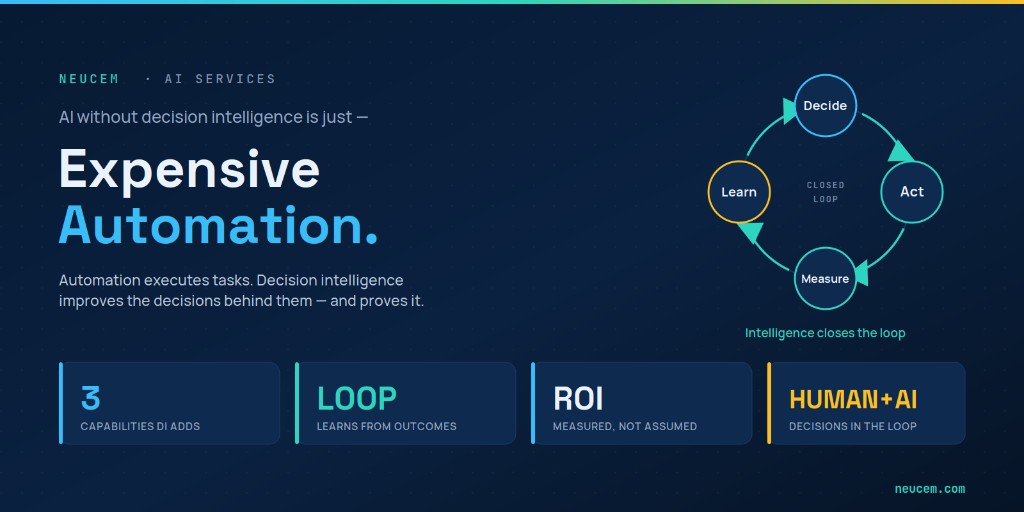
For the CIOs and CTOs we work with across India, that question is getting harder to answer. Budgets have flowed into AI, models are in production, and dashboards have multiplied — yet the decisions that actually move the business look much as they did before, only reached a little quicker. When AI accelerates a task without improving the judgment attached to it, you haven't bought intelligence. You've bought expensive automation.
The distinction matters more than it first sounds.
Automation executes. Decision intelligence decides better.
Automation is about doing the same thing faster and more consistently: route the ticket, generate the report, classify the image, send the alert. It is genuinely valuable, and for well-defined, repetitive tasks it pays for itself. But automation is indifferent to whether the underlying decision is any good. Speed up a flawed process and you simply reach the wrong outcome sooner.
Decision intelligence is aimed at the decision itself — the choice a person or system makes and the outcome it produces. It brings together the relevant data, the model's output, and the surrounding context to improve that choice: what to do, why, and what results. The test is simple. Automation asks, "did the task get done faster?" Decision intelligence asks, "did we make a better decision, and can we prove it?"
How "expensive automation" happens
The trap is rarely a bad model. It is where the AI is pointed. Most deployments bolt intelligence onto an existing workflow to accelerate the steps already there, without ever revisiting the decision those steps serve. The programme then gets measured on activity — tickets processed, documents summarised, minutes saved — because activity is easy to count. Outcomes, the thing leadership actually cares about, go unmeasured. The result is a system that is demonstrably busy and quietly failing to change anything that matters.
What decision intelligence actually adds
Three capabilities separate the two.
First, context. A recommendation is only as good as what surrounds it — current conditions, constraints, history, and the cost of being wrong. Decision intelligence pulls that context in rather than scoring a request in isolation.
Second, reasoning you can act on. It doesn't just output a number; it surfaces why, so the person accountable can trust it, override it when their judgment says otherwise, and learn from the gap.
Third, a closed loop. It tracks what the decision led to and feeds that outcome back, so the system improves against reality instead of drifting. Without this loop, you never actually find out whether the AI helped.
A concrete example
Consider a network operations team drowning in alerts. Automating triage — auto-classifying and routing every alert — is useful, and most teams stop there. But the decision that matters is not "which queue does this go to?" It is "is this worth waking someone up for, and what is the right response?" Decision intelligence weighs the alert against live context — recent changes, correlated signals, business impact — recommends an action with its reasoning, and then learns from whether that action resolved the incident. The first approach makes a noisy process faster. The second makes the night-shift decision better, and measurably so.
How Neucem builds for the decision, not the task
We start every engagement from the decision, not the tool. What choice are we trying to improve, who owns it, and how will we know it got better? From there we design the system backwards — instrumenting the outcome, building in the context and reasoning the decision needs, and closing the feedback loop so value compounds instead of plateauing. And we keep a human in the loop where judgment and accountability belong, so the AI informs decisions rather than quietly making unaccountable ones.
The difference in results is stark. Expensive automation shows up as activity. Decision intelligence shows up in outcomes you can take to the board.
If your AI is busy but your decisions haven't changed, the problem isn't the model — it's what the model was asked to do. That is exactly the gap we help close. Learn more about our AI services at neucem.com.